The Kamada Group is aware that we are engaged in the manufacture and sale of food products. Food safety is important to us. We would like to establish the following policy:
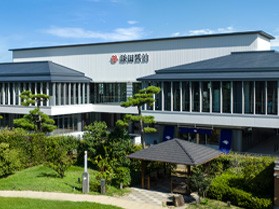
We have obtained and are operating under the FSSC22000, an internationally recognized standard for food safety, at our Honmachi and Minato factories.
Certification obtained on :
June 22, 2025:Honmachi Factory
July 30, 2025:Minato Factory
Certification body: Perry Johnson Registrars, Inc.
FSSC (Food Safety System Certification) 22000 is based on ISO22000, an internationally recognized standard for food safety
management systems, and is structured to include even stricter management items.
A third-party organization certifies that a higher level of food safety management has been achieved and that systems have
been put in place to deliver safe food to customers.
At our factories producing paper carton products, we at Kamada Soy Sauce have acquired HACCP certification by third-party assessment. We continue to improve on our food safety.

Date of certification:
March 11, 2019 (Honmachi Factory)
February 7, 2008 (Minato Factory)
Certifying body: Japan Food Certification Organization
HACCP is an acronym for “Hazard Analysis and Critical Control Point.”
It is a system for scientific analyzation and predicting biological, chemical, and physical hazards that may be present in food beforehand. The system constantly controls and records the processes by which they can be eliminated (or reduced to a safe level), in all steps, from receipt of raw materials to manufacturing and shipping.
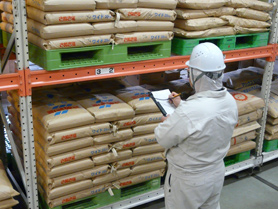
We are constantly checking for and recording any abnormalities from the receipt of raw materials to the shipping of completed orders. If an abnormality is found, it is promptly removed from the process.
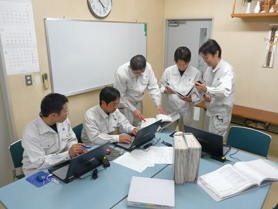
Through a process called “traceability,” we maintain records that allow us to identify raw materials used and products delivered to the customers. We regularly conduct traceability drills to check that records can be quickly retrieved.
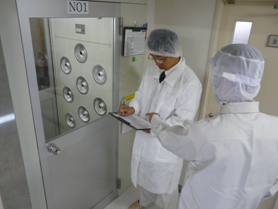
As part of our sanitary (food defense) process, we keep all records of entries from employees to visitors to every processing facility. Food defense is the effort to protect food from acts of intentional adulteration or tampering.
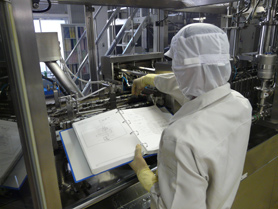
We created a manual for hygiene management. As part of that process, we inspect all machinery and equipment regularly. Strict records are kept of each inspection.
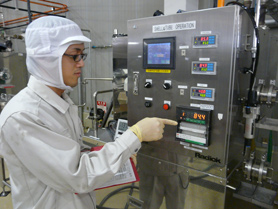
Inspections are conducted at each point in the process to ensure quality control.
KAMADA SOY SAUCE Inc. established its Quality Management System and obtained ISO 9001 certification in March 2002. After operating the management system for over 20 years, we believe that the objectives and principles have become thoroughly ingrained within the company and have been established as a mature set of procedures. Therefore, as of March 13, 2026, we voluntarily relinquished our ISO 9001 certification and adopted a self‑declaration of conformity for our Quality Management System, which is operated internally. In our future activities, we will strive for greater flexibility in responding to changes in social conditions and autonomous operations based on internal quality control and safety measures.
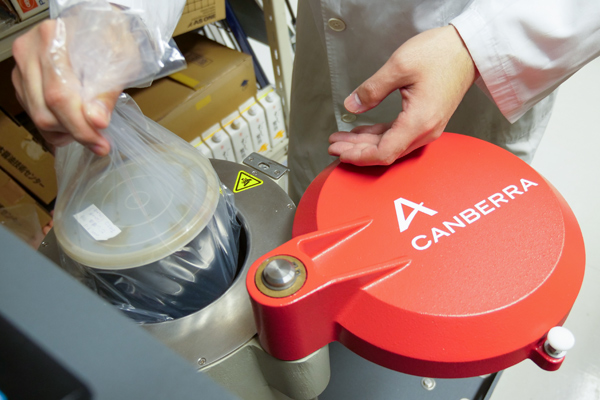
We have been performing voluntary testing for radioactive materials since March 21, 2012.
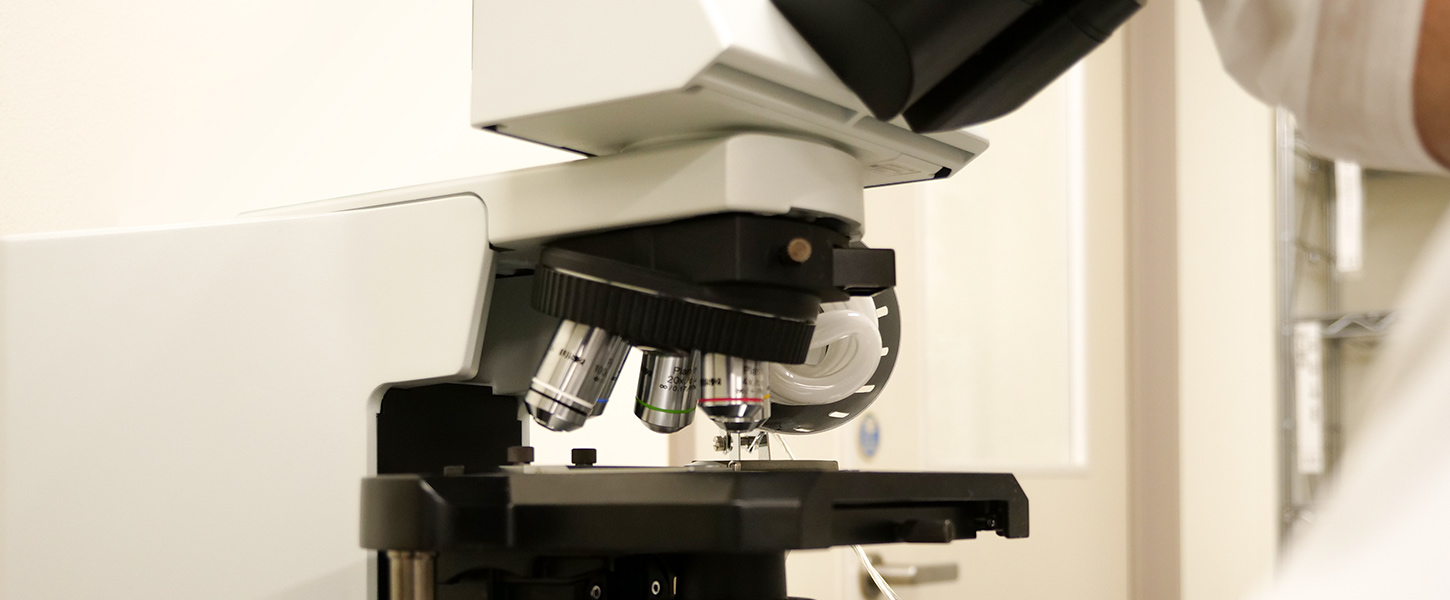
For the measuring device, we use a model that meets the performance requirements laid out in MHLW’s “Screening Methods for Radioactive Cesium in Food” (NaI (Tl) scintillation detector). Measurements are taken by inspectors who have passed the Radioactive Material Measurement Proficiency Test.
The measuring device complies with the latest standard (for general foods) as of April 1, 2012.
More than 30 types of domestically produced ingredients, including soy sauce and bonito shavings, are our main raw materials. These are inspected at each incoming lot and each production lot. The final product is also inspected before being packed in containers.
All products made at our factory are inspected at each production lot before packed. If the scintillation detector raises any red flags, it is subjected to a high-precision inspection by a Germanium (Ge) semiconductor detector at an external inspection facility.
Our in-house allowable limit for the final product is 2 becquerels per kilogram, which is just 1/50 of the 100 becquerels per kilogram limit for general foodstuffs set by MHLW. Since its introduction, we have completed measurement on 35,848 samples (as of March 31, 2025); to date, no detection in any of our final products has been observed.
(Last updated March 31, 2025)

We strive to gather allergy-related information involving all raw materials used.
We will disclose the information as it becomes available.
July 22, 2025
The content on this page is intended for allergens as defined by The United States Food and Drug Administration (FDA).
Currently, we only note allergens that can be investigated.
Please contact us for more information.
Milk, Eggs, Crustacean shellfish, Tree nuts, Peanuts, Wheat, Soybeans, Sesame, Fish |
Products |
Allergenic Labeling |
|---|---|
Dashi Soy Sauce |
Wheat, Soybeans, Fish (Mackerel, Tuna) |
Less Sodium Dashi Soy Sauce |
Wheat, Soybeans, Fish (Mackerel, Tuna) |
Salmon Dashi Soy Sauce |
Wheat, Soybeans, Fish (Salmon, Tuna) |
Vegan Dashi Soy Sauce |
Wheat, Soybeans |
Classic Dashi Soy Sauce |
Wheat, Soybeans, Fish (Salmon, Tuna) |
Classic Yuzu Soy Sauce |
Wheat, Soybeans, Fish (Tuna) |
Dashi Ponzu Soy Sauce |
Wheat, Soybeans, Fish (Mackerel, Tuna) |
Ponzu Soy Sauce |
Wheat, Soybeans |
Salad Dressing |
Wheat, Soybeans, Fish (Mackerel, Tuna) |
Teriyaki Soy Sauce |
Wheat, Soybeans, Fish (Mackerel, Tuna) |
Nizakana Soy Sauce |
Wheat, Soybeans, Fish (Salmon, Mackerel, Tuna) |
Dashi Soup Base |
Wheat, Soybeans, Fish (Mackerel, Tuna, Herring) |
Garlic Dashi Soy Sauce |
Wheat, Soybeans, Sesame, Fish (Tuna) |
Chili Dashi Soy Sauce |
Wheat, Soybeans, Fish (Tuna) |
Shellfish Soup Base |
Wheat, Soybeans, Fish (Mackerel, Tuna) |
Sashimi Soy Sauce |
Wheat, Soybeans |
Soup Base |
Wheat, Soybeans, Fish (Salmon, Mackerel, Tuna) |
Soba Soup Base |
Wheat, Soybeans, Fish (Salmon, Mackerel, Tuna) |
Sweet Udon Soy Sauce |
Wheat, Soybeans, Fish (Salmon, Tuna, Anchovy) |
Iriko Dashi Vinegar |
Fish (Anchovy) |
Soy Sauce |
Wheat, Soybeans |
Usukuchi Soy Sauce |
Wheat, Soybeans |
Udon Soup Base |
Wheat, Soybeans, Fish (Mackerel, Tuna, Anchovy, Herring) |
Dashi Chuno Sauce |
Wheat, Soybeans, Fish (Tuna, Anchovy) |
Hokkaido Kome Koji Miso |
Soybeans |
Kamada Katsuo Dashi Packs |
Fish (Salmon, Mackerel, Tuna, Anchovy, Flyingfish, Scad) |
Kamada Iriko Dashi Packs |
Fish (Anchovy) |
Shio Kombu |
Wheat, Soybeans, Fish (Mackerel, Tuna) |
Chirimen Sansho |
Wheat, Soybeans, Fish (Mackerel, Tuna) |
Shodoshima Somen noodles |
Wheat, Sesame |
Tokachi Soba noodles |
Wheat |
Sanuki Udon noodles |
Wheat |
Yuzu Vinegar Drink |
No allergens |
Apple Black Vinegar Drink |
No allergens |
Koji Amazake |
No allergens |
Dashi Shoyu Candy |
Wheat, Soybeans, Fish (Mackerel, Tuna) |
Tiny Rice Cracker (Garilc Dashi Soy Sauce |
Wheat, Soybeans, Sesame, Fish (Tuna) |
Tiny Rice Cracker (Dashi Soy Sauce |
Wheat, Soybeans, Fish (Mackerel, Tuna) |
Note that the content of the product you purchase and the content of the products listed on this website may differ slightly due to ongoing improvements.
Please read the ingredients noted on the package carefully before consuming.
Please contact us for current allergen information.

Shipping from Japan
Domestic Shipping in US
Domestic Shipping in Australia